Recent Confirmed OrdersLast 7 days
Australia2 gTirzepatide 100 mg · CagriSema 20 mg · BPC-157 10 mg · TB-500 5 mg · Melanotan II 10 mg · PT-141 10 mg · Bacteriostatic Water 3 ml
View all

Neurocognitive research

Dihexa

Peptide-like AngIV analogue with disputed foundational evidence · research use only

Lot-specific released result; request raw chromatography, assay and orthogonal identity data · target, verify batch COACAS 1401708-83-5RUO
Research statusPreclinical Research Use Only; no established human Dihexa clinical evidence
Supplied formN-hexanoylated peptide-like small molecule / peptidomimetic
Lead timeConfirmed with quote
Dihexa — Lot-specific solid; confirm physical form and colour on the released-batch COA
Dihexa — Lot-specific solid; confirm physical form and colour on the released-batch COA · Representative packaging image · verify the ordered lot
Representative packaging image · verify the ordered lot

Decision summary

Key benefits

  • No clinical benefit is established
  • Research relevance is limited to compound identity, evidence-integrity review, exploratory preclinical replication and analytical method development
  • Retracted or flagged results must not be converted into cognitive, synaptogenic, neuroprotective or anti-aging claims.
Published research context is presented for literature orientation only. It is not a dosing, treatment or human-use instruction.
Qualification data

Specifications to confirm against the released lot

CAS
1401708-83-5
Formula
C27H44N4O5
Molecular weight
Approximately 504.7 g/mol
Appearance
Lot-specific solid; confirm physical form and colour on the released-batch COA
Purity
Lot-specific released result; request raw chromatography, assay and orthogonal identity data · target, verify batch COA
Storage
Follow the released-lot COA and manufacturer stability instructions. Do not use retail capsule or DMSO protocol claims as stability data.
MOQ
On request
Lead time
Confirmed with quote
PubChem CID 129010512

Qualification matrix

Identity, purity and content are separate release questions.

Identity

Confirm the stated molecule and supplied form. Start with the matching batch COA; request sequence-level evidence only when the buyer's written procedure requires it and availability or a separate scope has been agreed.

Purity

Review RP-HPLC method conditions, wavelength, integration and related-peak handling. A percentage without the method is not enough.

Content

Net peptide content is not the same as gross lyophilized powder weight. Ask which assay supports the stated amount and whether water/counter-ion is addressed.

Stability

Define long-term storage and transit exposure separately. Cold-chain can be quoted when the buyer’s risk assessment requires it and adds cost.

Research context

What researchers study about Dihexa

Dihexa (PNB-0408) is a peptide-like angiotensin-IV analogue developed in preclinical cognitive research. Its evidence base is severely compromised: two foundational JPET papers were retracted in April 2025, and a third key paper remains under an unresolved Expression of Concern. One independent 2021 mouse study provides limited preclinical support, but Dihexa has no established human clinical evidence and is not an approved medicine.

  • Analytical identity and method development, critical appraisal of disputed preclinical evidence and carefully controlled exploratory laboratory research
  • These are research applications, not clinical indications.

Mechanism context

The question the literature is testing

The widely repeated HGF/c-Met binding and extreme potency narrative came principally from retracted papers and is not treated as reliable. An independent 2021 mouse study reported PI3K/AKT-associated observations, but it cannot restore the rejected mechanistic evidence or establish human relevance.

Evidence map

Research routes and exposure context

Evidence tierMixed evidence context
Routes reported in sources
No administration route applies
Dose / exposure contextProtocol-specific; verify the cited primary source
Routes and exposure contexts summarize cited studies or approved finished-product labels. They are not instructions for administering this RUO material; no customer dose is provided.

Evidence boundaries

Compatibility, limitations and decision context

  • Not for human or veterinary use
  • No established human Dihexa safety dataset exists
  • Theoretical pathway concerns and community side-effect reports are not substitutes for toxicology
  • Follow the SDS and institutional controls; analytical purity cannot establish clinical safety.

Interactions reported in the literature

  • Not established
  • No stacking, compatibility or patient drug-interaction advice is provided.
Literature context is not a supplier release result or human-use instruction. Follow your institution's approved laboratory risk assessment.

Factory batch documentation

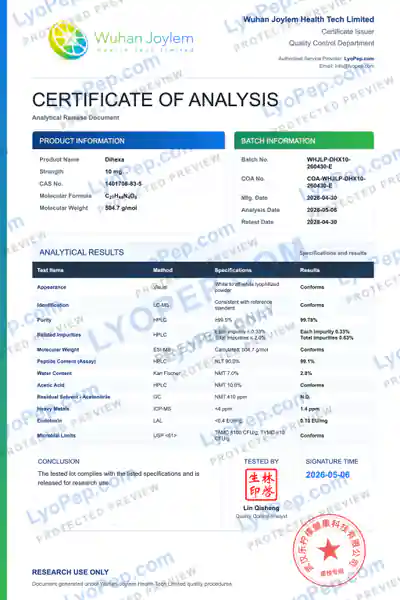
Dihexa factory batch COAs

Representative records, refreshed periodically

Published COAs show representative factory batches and may not be the latest available. For a current quote or shipment, our sales team can confirm the applicable lot and provide its COA.

Independent testing, arranged on request

Third-party reports are not routinely published. If independent verification is required, we can agree the laboratory, method, acceptance criteria and remedy before testing. If the agreed specification is not met, an appropriate resolution—including a refund where applicable—can be discussed under the agreed terms. Unless otherwise agreed in writing, the buyer pays the cost of this optional testing.

Help reviewing your COA

Need help reading a factory COA or third-party report? Our sales team can clarify test items, specifications and how the results relate to the lot under discussion.

Ask for the current packet, not a generic certificate

  • Require identity, structure and stereochemistry, LC-MS or orthogonal identity evidence, chromatographic purity and method, assay/content, water, residual solvents and relevant impurities
  • A valid COA establishes analytical attributes only; it does not validate disputed efficacy claims.
Released-batch COARP-HPLC result and method contextIdentity result appropriate to the moleculeWater / counter-ion context where relevantSDS and handling statementAdditional testing scoped on request

Available fills

Quote the fill and pack configuration you need

Reference SKUFillBase pack
PNB-10MG10 mg10 vials

Handling

Storage in the lab and temperature during transit are different decisions

Follow the released-lot COA and manufacturer stability instructions. Do not use retail capsule or DMSO protocol claims as stability data.

State destination, season, acceptable transit exposure and whether your protocol requires insulated or cold-chain service. Additional temperature-control cost is quoted explicitly.

Buyer FAQ

Terms to settle before the purchase order

Can a buyer arrange third-party testing?+

Yes. Testing must be performed by a mutually accepted, established specialist laboratory. Fee allocation, specification, sampling, method and acceptance rule must be agreed before testing; if an agreed independent result shows nonconformance, the remedy follows the signed order terms. Unless otherwise agreed in writing, the buyer pays the cost of this optional testing.

Does HPLC purity prove peptide content?+

No. Chromatographic purity describes the relative peak profile under a stated method. Identity, water, counter-ion, residual solvents and assay/content may require separate methods.

Is cold-chain shipping always required?+

Not always. Heat can accelerate degradation, especially during summer and long transit. Cold-chain reduces exposure but raises cost. State the destination and stability risk so the right service can be quoted.

How are payment terms handled?+

Available methods and milestones depend on order value, destination and project type. The pro forma invoice should state currency, bank details, fees, payment milestones and the release condition.

Why must the testing laboratory understand peptide chemistry?+

Free-base and salt forms, hydrophilic and hydrophobic sequences, aggregation and adsorption can change sample preparation and method suitability. Use a laboratory experienced with the molecule class.

These are buyer-qualification references, not claims that this RUO material is regulated, certified or released under those frameworks. Applicability depends on the buyer's workflow and jurisdiction.

Selected sources

Literature behind the research context

  • Identity: PubChem CID 129010512. Evidence integrity: the 2012 paper was retracted in April 2025 (DOI 10.1016/j.jpet.2025.103566), the 2014 paper was retracted in April 2025 (DOI 10.1016/j.jpet.2025.103567), and the 2013 paper retains an unresolved 2021 Expression of Concern. Independent preclinical context: Sun et al. 2021. Related but distinct molecule: fosgonimeton Phase 1 and LIFT-AD records. Research-misconduct reporting context: the January 2025 US Department of Justice Athira settlement; the resolved claims were allegations and did not constitute a liability determination.
  1. 01

    AngIV-Analog Dihexa Rescues Cognitive Impairment and Recovers Memory in the APP/PS1 Mouse via the PI3K/AKT Signaling Pathway

    Brain Sciences (MDPI) · 2021 · peer-reviewed original research (independent, non-WSU-group replication)

    Open source
  2. 02

    Evaluation of Metabolically Stabilized Angiotensin IV Analogs as Procognitive/Antidementia Agents

    Journal of Pharmacology and Experimental Therapeutics · 2013 · peer-reviewed original research — carries an unresolved Expression of Concern (image-manipulation allegations, 2021)

    Open source
  3. 03

    The Procognitive and Synaptogenic Effects of Angiotensin IV-Derived Peptides Are Dependent on Activation of the Hepatocyte Growth Factor/c-Met System [RETRACTED]

    Journal of Pharmacology and Experimental Therapeutics · 2014 · peer-reviewed original research — FORMALLY RETRACTED (data fabrication finding)

    Open source
  4. 04

    Development of Angiotensin IV Analogs as Hepatocyte Growth Factor/Met Modifiers [RETRACTED]

    Journal of Pharmacology and Experimental Therapeutics · 2012 · peer-reviewed original research — FORMALLY RETRACTED in April 2025 (falsified and/or fabricated data)

    Open source
  5. 05

    Safety, Tolerability, Pharmacokinetics, and Pharmacodynamics of the Positive Modulator of HGF/MET, Fosgonimeton, in Healthy Volunteers and Subjects with Alzheimer's Disease: Randomized, Placebo-Controlled, Double-Blind, Phase I Clinical Trial

    Journal of Alzheimer's Disease · 2022 · peer-reviewed clinical trial report (Phase I, registered trial)

    Open source
  6. 06

    LIFT-AD: A Study of ATH-1017 for Treatment of Mild to Moderate Alzheimer's Disease

    ClinicalTrials.gov (trial registry) · 2024 · clinical trial registry entry

    Open source
  7. 07

    Prospective Alzheimer's Drug Builds New Brain Cell Connections, Improves Cognitive Function of Rats

    WSU Insider (Washington State University official news) · 2012 · institutional press release (official university communications)

    Open source
  8. 08

    Four Papers by Athira CEO Earn Expressions of Concern

    Retraction Watch · 2021 · reputable science-integrity journalism (established, widely cited watchdog publication)

    Open source

Product FAQ

Questions buyers ask about Dihexa

How do the 2025 retractions change interpretation of Dihexa?+

The 2012 HGF/Met-modifier paper and the 2014 HGF/c-Met-dependent procognitive paper were formally retracted in April 2025 after findings of falsified or fabricated data. The 2013 synthesis, animal-efficacy and pharmacokinetic paper still carries an unresolved Expression of Concern. Claims of exceptional HGF binding, c-Met-dependent synaptogenesis, potency or long half-life derived from those papers cannot be presented as established evidence.

Is there established human Dihexa evidence?+

No established human Dihexa clinical evidence was located. A 2021 mouse study supplies limited preclinical observations, not human efficacy or safety. Fosgonimeton/ATH-1017 is a related but different molecule; its Phase 1 data and the negative primary and key secondary results of LIFT-AD cannot be assigned to Dihexa.

What can a COA establish for Dihexa?+

A lot-specific COA can support chemical identity, stereochemistry, chromatographic purity, assay or content, water, residual solvents and specified impurities when backed by suitable methods and raw data. It cannot repair a compromised evidence base or prove cognitive, synaptogenic, neuroprotective, anti-ageing, oral-bioavailability or human-safety claims.